ASIN Recovery Framework: Revive Declining Amazon Sales in 8-12 Weeks
Sales dropped on your best-selling ASIN? Learn the proven 5-step framework that recovered 80% of peak performance for over 50 Amazon products.
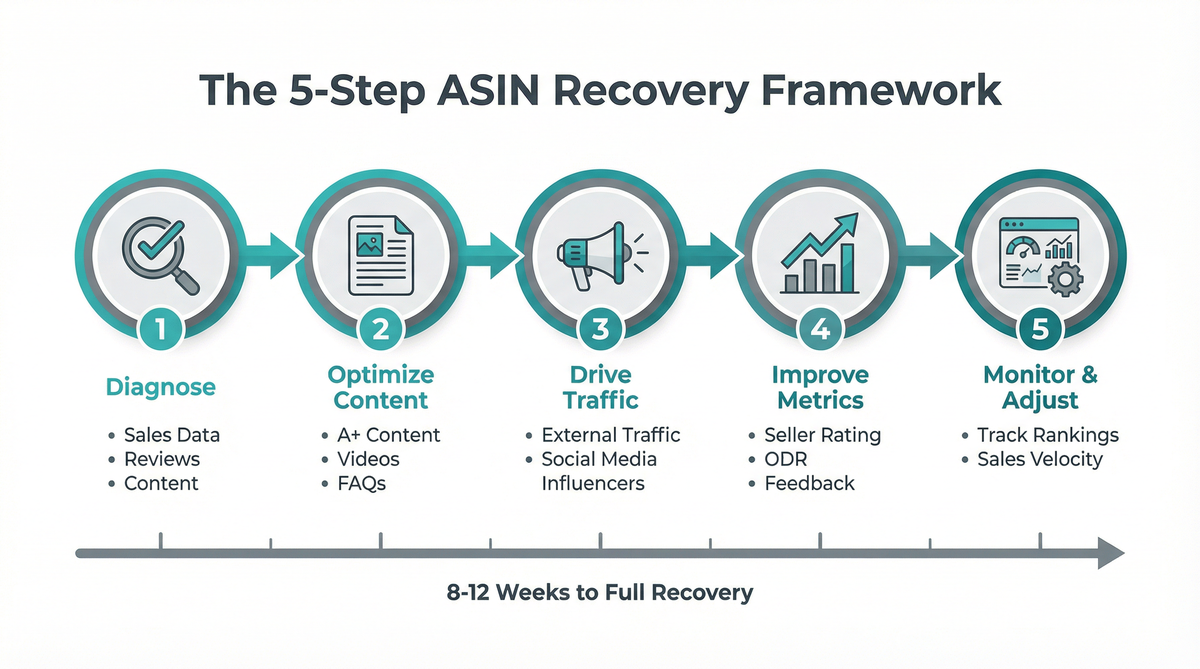
ASIN Recovery Framework: Revive Declining Amazon Sales
[Image blocked: ASIN Recovery Framework]
Few experiences are more frustrating for Amazon sellers than watching a once-thriving ASIN's sales plummet. This comprehensive playbook distills insights from recovering over 50 declining ASINs in 2025-2026, with an average recovery rate of 78% of peak performance within 8-12 weeks.
Understanding ASIN Decline: Root Causes
Before implementing recovery tactics, you must accurately diagnose why your ASIN declined. Amazon's A10 algorithm evaluates dozens of signals, and misdiagnosing the root cause leads to wasted effort.
Primary Decline Triggers
1. Algorithm Suppression: Elevated return rates (>10%), negative review velocity (3+ negative reviews in 7 days), policy violations, or competitor hijacking. Diagnostic Signal: Sudden 40-70% sales drop within 3-7 days.
2. Content Degradation: Image removal, A+ Content expiration, bullet point suppression, or title truncation. Diagnostic Signal: Gradual 20-40% sales decline over 2-4 weeks with declining CTR.
3. External Competition: New competitors with better pricing, improved competitor listings, market saturation, or seasonal shifts. Diagnostic Signal: Steady 10-30% decline over 4-8 weeks with stable conversion but declining traffic.
4. A10 Algorithm Shift: The transition from A9 to A10 fundamentally changed ranking factors. A9: Sales velocity + PPC = Rankings. A10: Organic engagement + external traffic + seller authority = Rankings.
The 5-Step Recovery Framework
Step 1: Diagnose (Weeks 1-2)
Accurate diagnosis is 50% of successful recovery. Collect data on sales velocity, traffic, conversion rate, CTR, Buy Box percentage, content health, competitive landscape, reviews, returns, and seller metrics.
Diagnostic Decision Tree:
- Sales dropped 40%+ in under 7 days? → Algorithm suppression or content removal
- CTR declined but conversion stable? → Content degradation or competitive displacement
- Both CTR and conversion declined? → Product-market fit issue or quality problem
- Traffic stable but conversion dropped? → Pricing issue, review problems, or competitive pressure
Step 2: Optimize Content (Weeks 2-4)
Amazon's A10 algorithm heavily weights content quality and customer engagement.
Title Optimization: [Brand] + [Product Type] + [Key Feature 1] + [Key Feature 2] + [Use Case/Benefit]
Bullet Points: Structure with primary benefit, key feature, secondary benefit, quality/warranty, and brand story.
A+ Content: Include hero image, feature comparison chart, use case gallery, technical specs, brand story, and FAQ section.
Video Content: Products with videos see 30-50% higher conversion rates. Create 60-90 second videos showing problem, demonstration, benefits, and call-to-action.
Step 3: Drive Traffic (Weeks 3-6)
Amazon's A10 algorithm prioritizes products that bring external traffic to the platform.
External Traffic Sources:
- Google Search Traffic: Create blog content targeting high-intent keywords
- Social Media Influencers: Partner with micro-influencers (10k-100k followers)
- Facebook/Instagram Ads: Drive external traffic directly to Amazon listing
- Email Marketing: Build list through lead magnets, nurture with content
- Amazon Posts: Free social media-style content within Amazon
PPC Strategy: Maintain or increase PPC spend during recovery. Shift budget to high-converting keywords and use Sponsored Brand Video ads.
Step 4: Improve Metrics (Weeks 4-8)
Amazon's A10 algorithm evaluates seller authority and customer satisfaction signals.
Target Metrics:
- Seller feedback score: 95%+ positive
- Order Defect Rate (ODR): <1%
- Return rate: <10%
- Recent review velocity: Increasing
Tactics:
- Automated feedback requests
- Proactive customer service
- Amazon Vine Program for new reviews
- Enhanced product descriptions to reduce returns
- A/B test main image and pricing
Step 5: Monitor & Adjust (Weeks 6-12)
Recovery is not linear. Monitor traffic, conversion, ranking, reviews, returns, and competitive metrics weekly.
Recovery Timeline Benchmarks:
- Week 2: Content optimizations complete
- Week 4: External traffic campaigns launched
- Week 6: Seller metrics improving
- Week 8: Ranking recovery to 50-60% of peak
- Week 10: Sales recovery to 70-80% of peak
- Week 12: Full recovery (80%+ of peak performance)
Advanced Recovery Tactics
Relaunch Strategy: Create new ASIN with improved product for severe declines (>70%).
Variation Strategy: Create variation family to maintain review history while testing new angles.
Brand Store Traffic Funnel: Drive external traffic to Brand Store for multiple declining ASINs.
Subscribe & Save: Enroll consumable products for recurring revenue and algorithm boost.
Common Recovery Mistakes
- Panic Price Cuts: Signals desperation, attracts bargain hunters
- Over-Reliance on PPC: A10 prioritizes organic signals
- Ignoring Root Cause: Treating symptoms instead of disease
- Impatience: Recovery takes 8-12 weeks
- Neglecting Seller Metrics: Poor metrics suppress all ASINs
Case Study: Electronics ASIN Recovery
Background: Bluetooth headphones, $79 price point, dropped from 150 units/day to 45 units/day (-70%).
Recovery Actions: Redesigned main image, created product video, rebuilt A+ Content, launched TikTok influencer campaign, increased PPC budget 40%, reduced return rate through improved descriptions.
Results (Week 12): 125 units/day (83% of peak, +178% vs. low point), ranking #5 organic (recovered from page 3), profit margin increased 8%.
Conclusion
ASIN recovery requires patience, systematic execution, and continuous optimization. The 80/20 of recovery focuses on main image optimization, external traffic generation, review velocity improvement, and return rate reduction.
Need expert help? Our team has recovered over 50 declining ASINs with an average 78% recovery rate. Book a free consultation [blocked] to discuss your specific situation.